
Retirement Isn't Just About "Later" Anymore. It's Shaping Choices We Make Now.

Retirement is usually treated as a later-life milestone. Increasingly, the same goals we associate with retirement (security, flexibility, control over time) are shaping decisions about work, housing, family and money much earlier in adulthood. That means the questions brands and researchers ask need to change too.

For a long time, retirement was relatively easy to locate.
It happened near the end of working life. You worked for decades, stopped, and then gained access to a bundle of things that had largely been deferred until later: more time, more freedom, more travel, a slower pace, and more control over your days.
That bundle is starting to come apart. People are taking career breaks and sabbaticals; they are talking about "mini-retirements" and financial independence; they are scaling work up and down rather than imagining one clear stop; and they are trying to make room for travel, caregiving, parenting, reinvention and rest while they are still very much in the middle of working life.
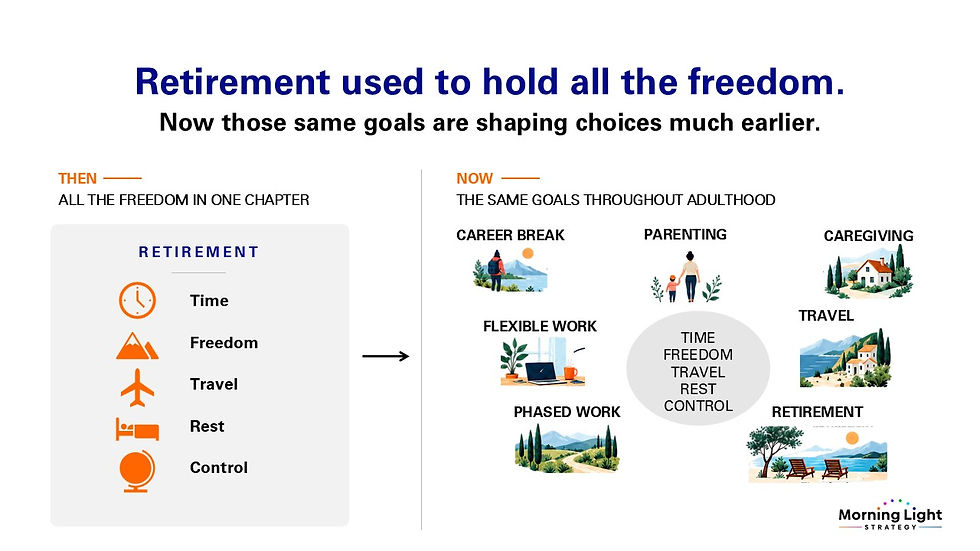
That cultural shift is already fairly visible. What interests me more is what it means for the way we study consumers.
Because once retirement stops being one discrete event at the end of adulthood, a lot of the decisions influenced by it no longer look like "retirement decisions" at all.
A retirement motivation can show up in a decision that looks completely unrelated.
Consider some of the choices people make in their 30s, 40s or 50s.
Do we buy the bigger house, or keep our fixed costs lower?
Do I take the promotion, or keep the flexibility I have now?
Can one of us step back from work while our kids are young?
Do we have another child?
Do we move closer to family because we expect caregiving responsibilities ahead?
Should I stay in a high-paying job for another 5 years, or switch to something I can imagine doing for much longer?
Do we take the expensive trip now, or keep putting that money away?
Would I rather maximize my earnings or get to a point where I have more choice over how much I work?
None of those questions necessarily gets filed under "retirement". But all of them can be influenced by the same underlying calculation:
How much do I need to protect the future, and how much flexibility do I want along the way?
That is a much broader consumer tension that "When do you plan to retire?"
Younger consumers make the limitations of the old framing especially clear
Younger households are being introduced to retirement saving earlier than previous generations were at the same age. The Investment Company Institute found that Gen Z households ages 18-25 are more than 3x as likely to have defined-contribution retirement accounts as Gen X households were at that age in 1989. Automatic enrollment and the growth of workplace retirement plans are a significant part of that shift.

But that does not mean retirement is their dominant financial priority. TIAA found that just 20% of 18-24 year olds were saving for retirement. When asked what they were saving for most, travel transportation and housing all ranked ahead of retirement. Its research also found a strong desire for financial freedom that could support career pivots, travel and professional breaks.
That combination matters: young adults can be exposed to retirement planning almost immediately while simultaneously thinking about financial security in much broader terms.
They may want to save for later and still want enough liquidity to change jobs. They may care about retirement and still prioritize buying a home. They may want long-term security and still believe that taking several months away from work at 35 is worth the financial tradeoff.
The increasingly visible idea of the "mini-retirement" is one expression of that. Reuters recently reported on younger professionals intentionally taking extended breaks during their careers rather than reserving that kind of time for the end of working life.
If we define the need too narrowly as "retirement", we miss what they are actually trying to accomplish.
And the choices are not equally available.
There is an important reality check here. The ability to optimize for flexibility assumes some degree of financial and career stability.
Recent college grads are currently entering a difficult labor market. In the second quarter of 2026, unemployment among recent college graduates was about 5.6%, while 42% were underemployed (Source: Federal Reserve Bank of New York).
That has consequences beyond the first job. Starting later can mean delaying employer contributions, early savings and income growth. Parenting, housing costs and caregiving can further change what a household has available to save.
So the story is not simply that people now value freedom over future security. Most people are negotiating both - under very different constraints. That makes understanding the tradeoffs more important than simply measuring the aspiration.
We need to ask about the decisions, not just the destination
A lot of retirement research still naturally gravitates toward questions like:
At what age do you expect to retire?
How much have you saved?
How confident are you that you will have enough?
Those questions still matter, but they don't tell us much about how the desire for future security is shaping life today.

There are other questions I would increasingly want in the conversation, like:
If you had enough financial cushion to make one change to your working life in the next 5 years, what would it be?
Work fewer hours? Change careers? Start something? Take several months off? Stay home with a child? Care for a parent?
Which household decisions make it harder to save for later - and which ones are you unwilling to sacrifice in order to save more?
Childcare? Housing? Education? Travel? Living near family? Health? Experiences with children when they are young?
When choosing a job today, what are you optimizing for?
Income? Benefits? Employer match? Flexibility? Remote work? Stability? Time off? The ability to stay in the role longer?
What are you deliberately choosing to do before retirement rather than waiting?
And perhaps most importantly:
What do you actually want your savings to buy you?
A retirement date?
Or the ability to say no to a job, take care of someone, work less, make a career change, travel, or absorb an unexpected transition without everything falling apart?
Those answers tell us something very different.
This matters beyond financial services
It's easy to see this as a retirement-industry issue - but it isn't.
The same tradeoffs affect categories as varied as housing, travel, workplace benefits, healthcare, education, childcare and caregiving.
A housing brand might need to understand whether affordability is valuable because someone wants a larger home now or because lower fixed costs preserve future flexibility.
An employer might discover that the retirement match is only part of what "financial security" means to an employee who also values paid leave and the ability to step back during a caregiving period.
A travel brand may be competing not just for discretionary spending, but with an internal rule about how much of life should be enjoyed now vs. funded later.
A health & wellness company may find that staying healthy is less about an abstract desire for longevity than about preserving the ability to work, travel, care for family and remain independent on someone's own terms.
Those distinctions affect positioning, product design, benefits, messaging and segmentation.
Maybe "retirement" is becoming too narrow a lens
Retirement still matters as a life stage and a financial goal, but treating it only as something that happens near the end of working life risks missing how deeply the same needs are already embedded in decisions across adulthood.
The more useful unit of analysis may be less "retirement readiness" and more "desired optionality".
How much control does someone want over work? What are they unwilling to postpone? Which responsibilities constrain their choices? What future are they trying to protect? And what would enough financial security allow them to do differently before they ever retire?
Those are questions brands can actually use - because if work, family, caregiving, saving and time are being negotiated differently across a longer adulthood, we shouldn't expect the old retirement questions to explain new decisions.
About Morning Light Strategy: Morning Light Strategy is a boutique insights & advisory agency. We help brands find clarity when consumers are shifting, briefs are tricky, and the path forward isn't obvious. From menopause to identity shifts, caregiving to cultural change, we specialize in emotionally complex life transitions that reshape behavior.
To learn more, visit: www.morninglightstrategy.com


